

Welcome to my monthly highlights! Inspired by White Cube Bermondsey’s amazing 3x3x3 room (the space for monumentally sized work), I will include 3 free exhibitions in London, 3 paid exhibitions in London, and 3 exhibitions outside London every month.
This month I have so many great exhibitions to share that it may be hard to choose! But fortunately most of these are open for some time.
3 x FREE IN LONDON:
Whitechapel gallery: Candice Lin, g/hosti until 1 March 2026
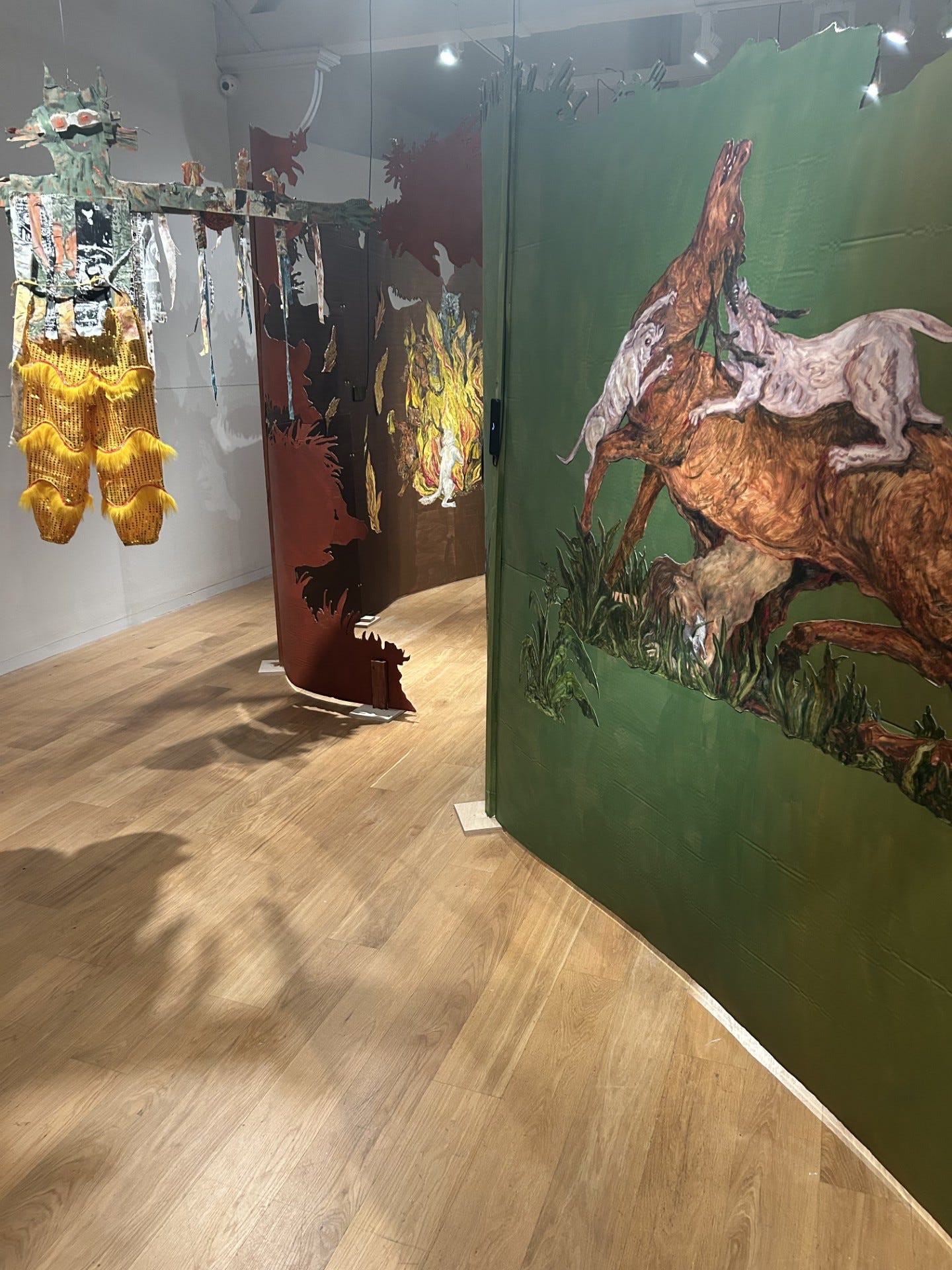
Candice Lin’s installation is incredibly rich in detail. Her cardboard maze at first glance looks like a magical forest but soon turns into something more sinister, with phone screens suspended between the foliage showing scenes of violence, and animals displaying their savagery. American-born, LA based Lin was commissioned to make the work during university protests and the recent fires in her community in LA, but the installation transcends the local and the specific. What Lin’s labyrinth-like form so powerfully conveys is that there is no way to hide for us humans.
*** Why not join my group tour on Wednesday 26th November, 4.30-6pm?
Details here ***
White Cube Bermondsey: Cai Guo-Ciang, Gunpowder and Abstraction 2015-2025, until 9 November
The artist just orchestrated a spectacular firework display on the façade of the Centre Pompidou for the opening of Art Basel, bringing the risky and dangerous experimentation with gunpowder into the realms of contemporary art. His resulting paintings move between figurative and abstract, and connect Western concerns of abstraction with Eastern philosophical thought. Notions of creation and deconstruction and of control and chance speak to the rhythms of our cosmos.Josh Lilley gallery: Rember Yahuarcani, Here Lives the Origin, until 20 November 2025
I discovered the artist from Peru at the last Venice Biennale, curated by Adriano Pedrosa, where his monumental but intricate paintings on bark were beautifully installed opposite those of his father, Santiago, who has his own public exhibition at the Whitworth Manchester (see below). Both belong to the Aimeni (White Heron) clan of the Uitoto Nation of northern Amazonia, and Rember’s luminous paintings on a black background convey a rich world populated by insect-like figures that balance precariously on tree branches and seem to be brimming with the music of the natural world.
3 x PAID IN LONDON:
Royal Academy: Kerry James Marshall, The Histories, until 18 January 2026
So irreverent yet so art-historically significant, at once witty and with gravitas, Marshall engages with black histories subtly and powerfully. He is one of the great artists, who took from the rich art histories that preceded him and who is so influential on the histories that come after. His painting School of Beauty, School of Culture (2012) in the last room has one of my favourite image ever: two toddlers like putti admiring a Disney princes positioned like the skull in Hans Holbein’s Ambassadors.Courtauld Gallery: Wayne Thiebaud, American Still Life, until 18 January 2026
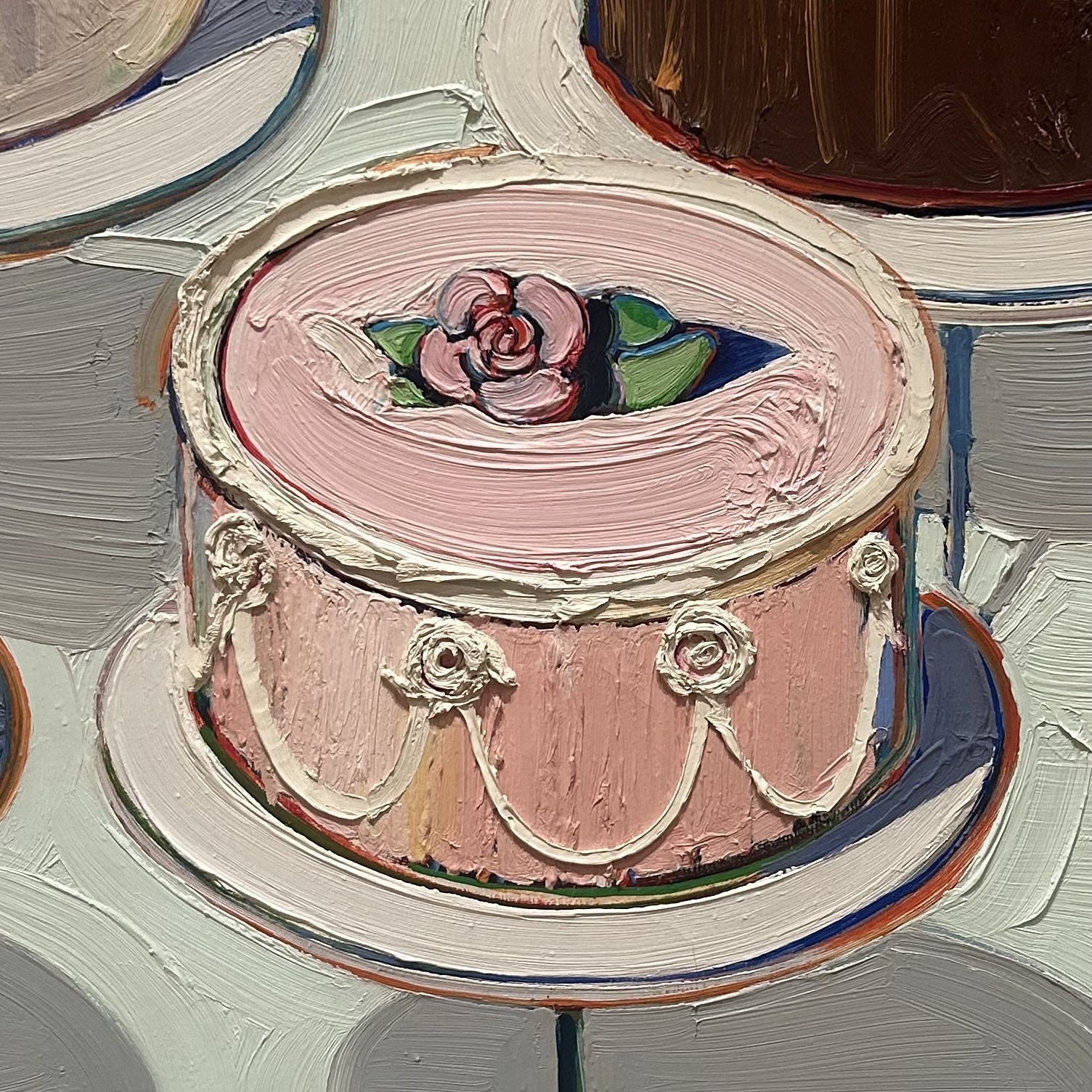
Thiebaud describes his still lifes as ‘small landscapes, buildings or characters in a play with costumes’. The paintings are so textured, so lush that they just make you want to touch, lick or eat the cakes and the candied fruit and the sweets. Thiebaud trained as a sign painter and that directness still shows, but his objects of consumerism are more complex and mysterious than that. The sweet jars miss handles so the consumer is stuck in their desire; the sausage and cheese counter was inspired by Manet’s Bar at the Folies Bergere - both paintings putting you right at the counter.Whitechapel Gallery: Joy Gregory, Catching Flies with Honey, until 1 March 2026
Another one at the Whitechapel, to combine with Candice Lin. This will be the first major survey of the artist spanning four decades. Gregory is one of the UK’s most innovative artists working in photography, and her works are as much concerned with questions of identity, race and gender as with the craft of photography itself. Working often in series, and with historic photographic processes, this is an exhibition that requires time and close looking, so perfect as an antidote to all that art flashing by on Instagram. I loved the artful photographs of clothes standing in for human personality traits and background!
3 x OUTSIDE LONDON:
Royal Scottish Academy, Edinburgh: Andy Goldsworthy, Fifty Years, until 2 November
Conceived by the artist as a single, immersive artwork in response to the space, this is a unique chance to see Goldsworthy’s new and past artworks in an exhibition, as his art is usually made directly in nature. Much of contemporary art is concerned with nature in the context of climate change and Indigenous practices, but Goldsworthy’s art lets you feel the everyday beauty of nature and our connection to it without becoming preachy. Unfortunately I have to give this one a miss, as I will be travelling to exhibition nr 3 in Florence.
Whitworth Manchester: Santiago Yahuarcani, The Beginning of Knowledge, until 4 January 2026
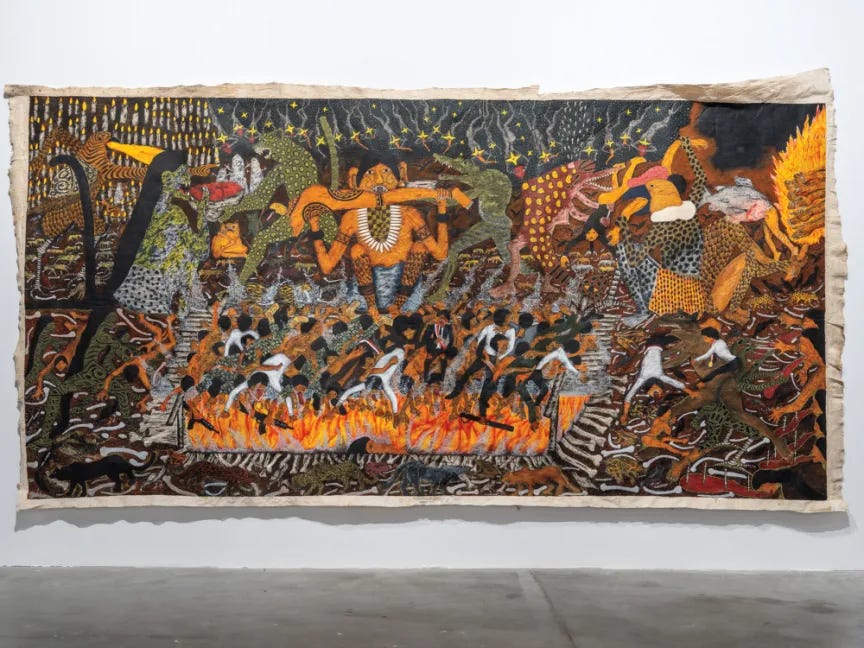
I discovered the artist from Peru at the last Venice Biennale, curated by Adriano Pedrosa, where Santiago’s monumental but intricate paintings on bark were beautifully installed opposite those his son, Rember. Both belong to the Aimeni (White Heron) clan of the Uitoto Nation of northern Amazonia and Santiago’s paintings, while carrying references to colonial violence, also have their own unique visual vocabular of ancestral symbols, medicinal plants and Amazonian stories of life’s origins. Tate acquired a large painting on bark at Frieze London in 2023, so it is fitting that his first international solo show is around the same time, and in the UK.Palazzo Strozzi, Florence: Fra Angelico until 25 January 2026
A once-in-a-generation exhibition of arguably the most spiritual of the Renaissance painters brings together over 140 religious scenes, amongst which seven major altarpieces whose individual elements were dispersed over time. “Assembling this many Fra Angelicos is almost a miracle,” wrote the New York Times, of curator Carl Brandon Strehlke’s incredible achievement. San Marco shows the artist’s illuminated manuscripts and his paintings in the cells of the Dominican monks, while the more substantial eight rooms in the Palazzo Strozzi show his religious paintings and altarpieces. The angelic friar (“beato angelico”) is often considered as much a saint as an artist, but these two exhibitions place him firmly in his time, working with the Medici family and experimenting with both gothic and renaissance styles.